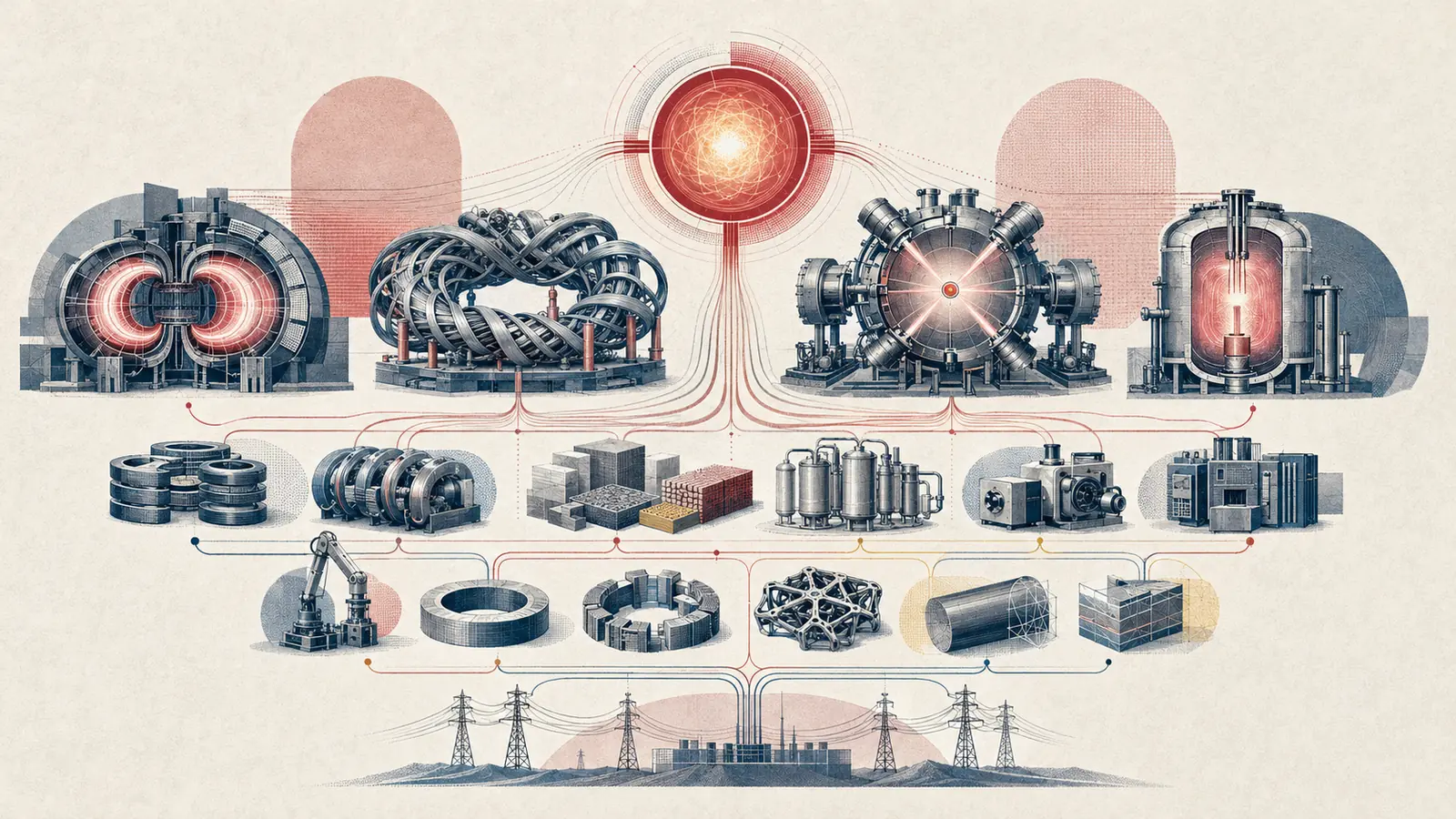
Fusion will be won or lost by the industrial platform surrounding the machine: materials, drivers, magnets, diagnostics, fuel, manufacturing, regulation and talent.
The public story of fusion is usually told as a race among reactors. That makes for a clean scoreboard, but it obscures the harder and more consequential contest. A reactor concept becomes an energy system only when dozens of scientific, industrial and institutional capabilities mature around it.
The Stanford–SLAC report Extreme Energy in Time to Make a Difference gives this surrounding structure a useful name: a fusion platform. The platform begins with matter in extremes, including the behavior of plasmas and materials under extraordinary heat, pressure, radiation and mechanical stress. It extends through sensors, simulation, artificial intelligence, advanced manufacturing, fuel cycles and heat extraction. It ends with pilot facilities, supply chains, skilled people, finance and rules that make deployment possible.
That definition changes where attention and capital should go. A simple reactor race leaves shared bottlenecks until too late. Neutron-resistant materials, tritium accountancy, remote maintenance, high-efficiency drivers and a skilled operating workforce can improve several architectures at once.
Interfaces are where the platform earns its name. A better material has limited value if it cannot be joined, inspected or replaced. A stronger magnet needs power electronics, cryogenics, protection systems and a manufacturing process with acceptable yield. A diagnostic becomes more valuable when its data can inform control and validate simulation. Progress compounds when the output of one capability is designed to become the input of the next.
A platform view also changes how milestones should be read. Plasma gain, target gain and a record temperature can be genuine scientific achievements without proving plant economics. The relevant question is not whether a milestone is real. It is where that milestone sits inside the total system, which risks it retires and which interfaces remain unresolved.
The commercial implications are equally important. Some of the most durable businesses in fusion may sell into several reactor programs long before electricity reaches the grid. Magnets, power electronics, precision targets, diagnostics, materials qualification, simulation and robotics can form markets while the industry is still learning which power-core architectures scale best.
Policy should reflect the same humility. Technology neutrality is not a refusal to choose forever; it is a way to let evidence arrive before public institutions lock the field into a premature design. Government has a decisive role in foundational science, shared infrastructure, safety and first-of-a-kind scale capital. It should be exacting about outcomes and cautious about prescribing machines.
There is a danger in platform language. It can become an alibi for committees, diffuse grants and facilities with no demanding users. The remedy is operational: publish access rules, measure test turnaround, require industry participation, compare results and retire programmes that do not reduce a declared risk. A platform should be judged by the experiments and companies it makes possible, not by the breadth of its diagram.
The reactor remains the center. But the platform determines whether the center can become an industry. That is the frame through which The Fusion Platform will cover the field.