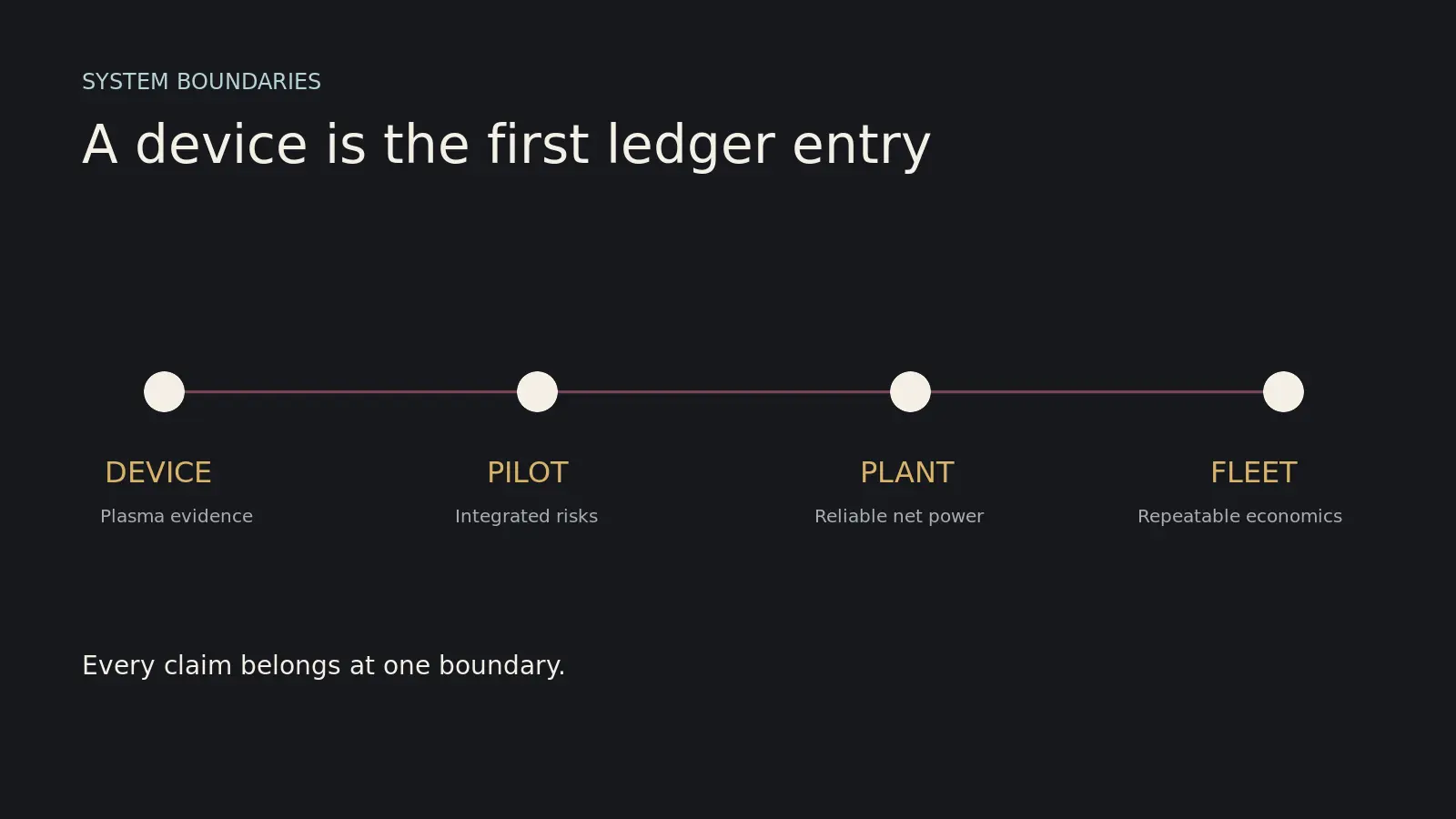
Fusion schedules become legible only when each claim is located on the full path from plasma experiment to repeatable infrastructure.
Fusion discussion often compresses several different achievements into one word: commercial. A device can demonstrate plasma performance. A pilot plant can integrate heat extraction and fuel systems. A commercial plant must deliver reliable net electricity. A fleet must be financeable, manufacturable and operable across sites.
Each transition changes the dominant risk. Physics uncertainty gives way to component lifetime, integration, licensing, construction, availability and supply-chain throughput. A schedule that names the endpoint without showing these transitions is not yet a plan.
Energy claims require the same separation. Plasma gain, target gain, engineering gain and electricity exported to the grid use different inputs and boundaries. A useful announcement states the numerator, denominator, duration, repetition rate and equipment excluded from the calculation. Without those details, two accurate gain numbers can describe radically different stages of readiness.
This does not mean every developer must build a conventional utility project. Some architectures may first create value in scientific systems, propulsion, industrial heat or specialized power markets. The same discipline applies: define the product, its system boundary and the repeatable unit of scale.
The Fusion Platform will therefore report milestones with four questions attached. What was measured? Where is the energy boundary? Which system risk was retired? What must happen next?
Precision is not pessimism. It is how a serious field protects its credibility while moving quickly.