America is favourite to build the first credible commercial-style pilot. China is better placed to build the second, tenth and fiftieth plants. The latter is the race that matters.
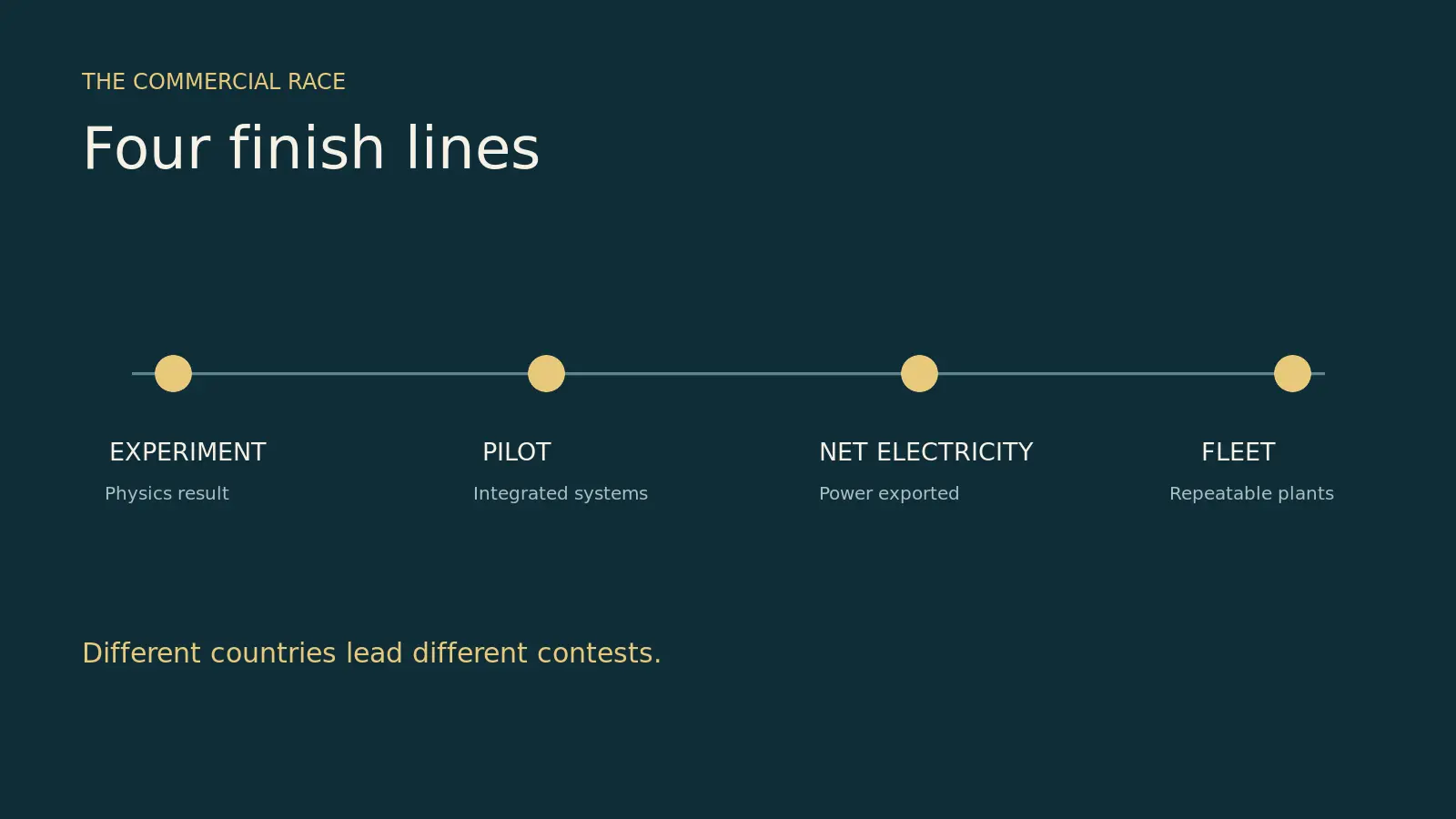
The fusion race suffers from a defective stopwatch. Four finishes are routinely treated as one: the first decisive experiment, the first pilot, the first plant to export more electricity than it consumes, and the first fleet that can be built repeatedly at a tolerable price. They reward different strengths. Our base case is that America wins the prototype contest and China wins commercialization. The United States can alter that outcome by converting its remarkable start-up lead into an equally serious system for building things.
The experimental crown is already fractured. America’s National Ignition Facility achieved laboratory ignition first. China’s EAST sustained high-confinement plasma for 1,066 seconds. Japan and Europe built JT-60SA, the largest superconducting tokamak; South Korea’s KSTAR is a formidable test bed for long-pulse control. These are genuine achievements, but an experimental record is not a power station. Plasma physicists measure confinement, temperature and gain. Utilities eventually ask about availability, maintenance intervals and the price of electricity. The second list is less glamorous and considerably more commercial.
Six contenders; six different advantages
| Contender | Present edge | Principal risk |
|---|---|---|
| United States | Private capital, architectural competition and national-laboratory depth | Industrial infrastructure may lag the prototypes |
| China | Coordinated infrastructure, heavy industry and repeatability | Costs and system boundaries are less transparent |
| United Kingdom | Coherent programme, site and proportionate regulation | Narrower capital and manufacturing base |
| European Union | Deep supplier network and ITER experience | Institutional tempo |
| Japan | Precision machinery, superconductors and JT-60SA | Fewer scaled commercial integrators |
| South Korea | Long-pulse research and heavy-engineering discipline | Smaller private-capital ecosystem |
America leads the commercial-style pilot contest. Its firms dominate private fusion, while the Department of Energy’s finalized Fusion Science and Technology Roadmap aligns laboratories, universities and industry around pilot plants and commercial power in the mid-2030s. America has capital, competing designs, prospective customers and a regulatory theory. What it lacks is qualified blankets, fuel-cycle equipment, materials and suppliers at fleet scale. Venture capital can finance a machine; it cannot conjure an industrial base by term sheet.
China is making the opposite wager. BEST is intended to demonstrate net fusion power gain and fusion-generated electricity around 2030, though that official ambition does not amount to net electricity from a complete plant. Around it sit EAST, CRAFT, ITER-derived manufacturing capability, state-backed finance and a planned fusion cluster in Hefei. China combines its plasma programme with the ability to coordinate land, infrastructure, patient capital, heavy industry and follow-on orders. A state can replicate an uneconomic machine with impressive efficiency. Even so, if the machine works, China is the country most capable of turning one into fifty.
China’s apparent advantage carries its own discount. Coordinated construction can preserve a programme through setbacks, but it can also protect weak designs from the discipline of comparison. Public information may establish that a component was built without making its cost, yield or operating history equally legible. Fleet leadership requires learning from failures as well as mobilizing factories. Opacity can slow that learning when suppliers, operators and outside researchers cannot examine the same record.
Britain has the most coherent programme relative to its size. STEP is a named plant on an acquired site, backed by a national systems integrator and intended to operate from 2040. Britain has also chosen a proportionate fusion regime separate from fission. This is unusually joined-up government. Yet it has less private capital and a narrower manufacturing base than America, China or the European Union. Strategic clarity can compensate for scale. It cannot abolish it.
Europe possesses much of the industrial substance but not yet the tempo. ITER is an experiment, not a generator, and it will produce no electricity. European suppliers are nevertheless strong in vessels, remote handling, diagnostics, construction and nuclear engineering. Japan and South Korea may become the race’s kingmakers: both understand superconductors, precision machinery and repeatable manufacturing better than most fusion start-ups. Their early victory may be to sell indispensable components to everybody.
A proper commercial scorecard should test the complete boundary. It should ask whether a plant exports net electricity after internal loads, whether fuel and heat systems close, how often components are replaced, how long outages last, what construction costs, and whether suppliers can deliver the next unit faster. The first plant may set standards, win customers and train a workforce, so speed still matters. Yet the fiftieth plant reveals whether the underlying system learned.
America’s countercase rests on adaptation. Competition among architectures can kill weak ideas earlier, redirect talent and reward a design that uses fewer scarce inputs. Customers can impose requirements that a state programme might discover later. These strengths work only if the country builds shared test infrastructure and manufacturing capacity before a winner is obvious. Otherwise architectural competition produces several ingenious islands with no bridge to deployment.
The verdict is deliberately untidy but not agnostic. America is the narrow favourite for the first commercial-style pilot and first net-electricity plant. China is the favourite for the first repeatable fleet, which makes it our favourite to win fusion’s commercial race. The champion will not be the country that makes a fusion-powered lamp glow for a press photograph. It will be the one that makes the fiftieth plant boring.