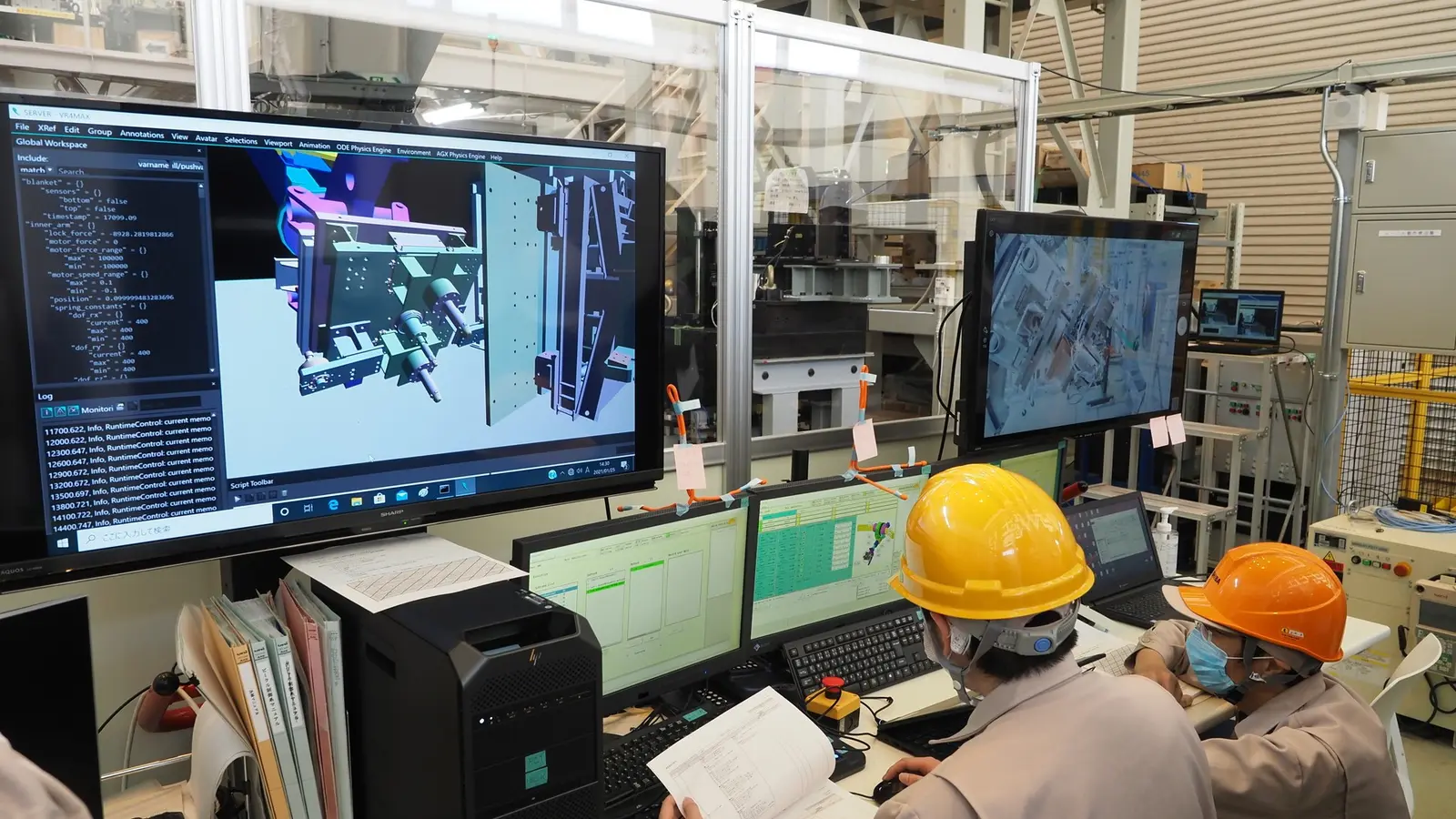
Components inside a fusion machine will be difficult or unsafe to service by hand. Maintenance architecture therefore sets availability, component design and plant economics.
A fusion plant may be judged by what happens when it stops. Components near the plasma face heat, particles and, in many designs, energetic neutrons. Some will need inspection or replacement in environments that make routine human access impractical. The maintenance machine is therefore not an accessory to the reactor. It is one of the reactor’s operating systems.
ITER makes the scale of the problem visible. Separate remote-handling systems are intended for blanket modules, divertor assemblies and neutral-beam equipment. Every interface must permit a tool to find, grip, disconnect, move and reinstall a component with high reliability. A fast component replacement on a drawing can become a long outage when alignment, contamination control or recovery from a failed operation is ignored.
Maintenance requirements flow upstream. They determine segmentation, ports, connectors, lifting paths, building layout, spare inventories and inspection methods. They also influence materials choices: a component with a shorter lifetime may still be tolerable if replacement is rapid and predictable, while a theoretically durable component can be disastrous if it cannot be removed.
A maintenance operation is an engineered chain
- 01Detect
Identify degradation before it becomes an unplanned outage.
- 02Isolate
Make the work area and connected systems safe.
- 03Access
Move tools through ports and structures designed for the task.
- 04Replace
Disconnect, transport and install components remotely.
- 05Verify
Inspect alignment, seals and function before restart.
- 06Recover
Provide a credible procedure when a tool or component fails mid-operation.
Maintenance does not end when a component leaves the vessel. ITER’s cask-and-plug system transfers activated equipment to the Hot Cell Complex for repair, refurbishment or replacement. Commercial outage models should therefore include the in-vessel task, shielded transport, hot-cell capacity and the return path.
Recovery deserves equal standing with the planned procedure. A robot can lose power, a connector can seize and a component can move outside its expected path. If the only tool capable of recovering a failed tool is blocked by the same failure, a routine intervention can become a long outage or expose expensive equipment to further damage. Because activation and contamination can sharply constrain direct human access, designs may need independent observation, redundant routes, recoverable end effectors and rehearsed off-normal sequences.
The commercial metric is availability. Revenue depends on the fraction of time a plant can deliver its product, while financing depends on confidence in that fraction. Remote handling converts component physics into an outage distribution.
Uncommon alignment errors or damaged interfaces can dominate lost time. Mock-ups and simulations need representative tolerances, loads and failure cases. Investors should seek demonstrated task and recovery times rather than a video of the nominal motion.
Developers should publish maintenance assumptions with the same seriousness as plasma targets. The most impressive fusion core will not rescue a plant designed around an impossible service procedure.